

Visual Art Diaries and Sketch Journals for Students

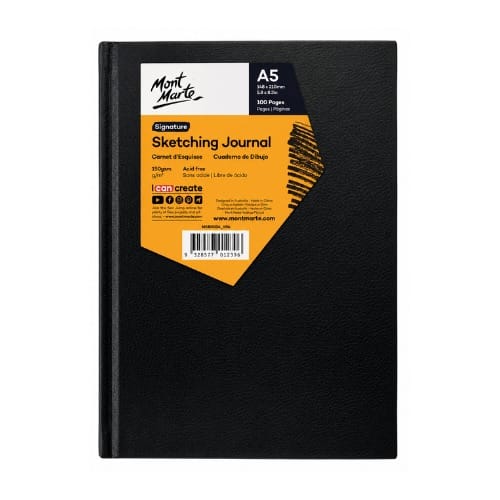
A visual art diary is where ideas start. Art teachers ask students to keep one, and many artists fill a sketch journal every week with studies, notes, colour tests and collage. This Haanz Art Guide compares the Mont Marte diaries, journals and sketch books we stock and gives simple ideas for filling the pages.
Diaries, journals, pads: what’s the difference?
- Visual art diary: a bound book for mixed notes, sketches, colour swatches and pasted images. Lighter paper, many pages.
- Sketch journal: a bound book with heavier paper for drawing, often with a nicer cover. Good for keeping and showing.
- Sketch pad: loose or tear-off sheets for drawings you may remove, mount or submit.
- Sketch book (large): a big bound book for everyday drawing practice.
What we stock
Mont Marte Visual Art Diary, 110gsm, 120 pages. A versatile journal format for art students. Available in A5 and A4. A5 fits in a school bag; A4 gives more room for collage and mind maps.
Mont Marte Sketch Journal, Croc cover, 150gsm, 100 pages. Heavier paper with a stylish croc-textured cover. Available in A5 and A4. A lovely choice for a personal sketchbook or a gift.
Mont Marte Sketch Pad, 150gsm. A sturdy pad for pencil, charcoal and pastel drawing, available in A5, A4 and A3.
Mont Marte Sketch Book, 110gsm, 80 sheets, A3. A large sketch book for art students and daily sketching.
Browse more in Drawing Papers. Prices change, so see each product page for today’s price.
Which one should you buy?
- For an O/L or A/L art diary: the A4 Visual Art Diary, or the A4 Sketch Journal if you want heavier paper.
- For sketching on the go: an A5 journal.
- For daily practice drawings: the A3 Sketch Book.
- For drawings you will tear out and submit: a Sketch Pad.
- For light watercolour or markers: choose 150gsm pages over 110gsm, as heavier paper buckles and bleeds less.
How to fill an art diary
Your diary is about the process, not perfect pictures. Try:
- Observation sketches: quick drawings of objects, people and places around you.
- Colour swatches: paint or pencil swatches with notes on mixes.
- Material tests: try a new pencil, pen or paint and note how it behaves.
- Mind maps: write a theme in the middle and branch out ideas.
- Collage: paste photos, tickets, fabric scraps and magazine cuttings for inspiration.
- Artist studies: copy a small part of a painting you admire and write what you learnt.
- Notes and reflections: what worked, what didn’t, what you’ll try next.
A page a day, even a quick one, builds skill fast. See Art Journaling for Beginners for more ideas.
Tips for better pages
- Date every page. Teachers and examiners like to see development over time.
- Use light pencil grades for planning so you can erase cleanly.
- Use a sheet of scrap paper under your hand to avoid smudging.
- Use glue sticks rather than wet glue for collage, so pages don’t wrinkle.
- Fix charcoal and pastel pages so they don’t transfer to the opposite page.
Frequently asked questions
Is 110gsm paper enough for an art diary?
For pencil, pen and collage, yes. For heavier media such as markers or watercolour, choose the 150gsm journal.
Can I use both sides of the page?
With pencil and pen, yes. With wet media or markers, the other side may show through, so many artists use one side only.
A5 or A4?
A5 is easy to carry everywhere. A4 gives more space for school projects and collage.
Do you deliver islandwide?
Yes. We deliver across Sri Lanka in 2–5 working days, with cash on delivery, card or bank transfer. You can also visit our shops in Boralesgamuwa and Horana, open every day from 9 AM to 6 PM.
Not sure what to choose? WhatsApp the Haanz team on 0711 515 515 and we’ll help you choose a diary or journal.
More Haanz Art Guides
 Polymer Clay Earrings: How to Make Your First Pair at HomeRead the guide →
 Art Studio Accessories: Aprons, Brush Pouches and Drawing TubesRead the guide →
 Air Dry Clay for Beginners: Types, Drying Tips and PaintingRead the guide →
 UV Resin for Beginners: How to Use It and What You NeedRead the guide →
