

Study Stationery for Students: Highlighters, Pens and Notebooks

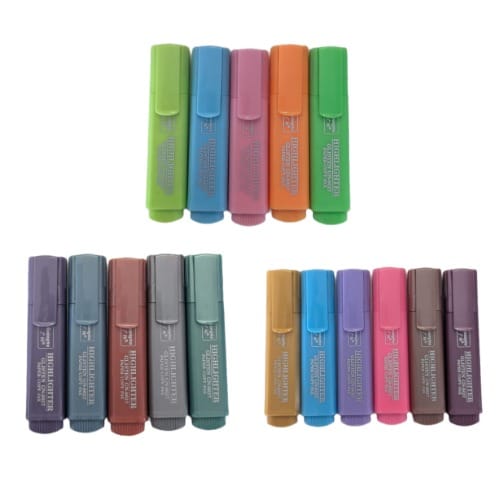
Neat, colourful notes are easier to read, remember and revise. This guide covers the study stationery students use most for notes and revision: highlighters, multi-colour pens, sticky note strips and notebooks, plus a simple colour-coding system that makes exam revision much faster.
Study stationery: highlighters
- Artline Highlighter Pens: bright ink with a chisel tip, in green, orange, pink or yellow, sold individually.
- Glitter Highlighter Marker: sparkly highlighting in 16 colours, including Gold, Silver and Rose Gold, for notes, journals and cards.
A chisel tip lets you highlight a full line with the broad side, or underline with the narrow edge.
Pens and pencils for notes
- Retractable Ballpoint Pen (4 colours): four colours in one pen, handy for colour-coding.
- Ball Point Refills (5 pcs) for ballpoint pens.
- A Pentel 0.5mm mechanical pencil for diagrams that stay sharp. See our mechanical pencils guide.
- Dual Tip Water Soluble Markers for neat headings with a brush tip and a fine tip.
Notebooks, sticky strips and storage
- Spiral notebooks that lie flat in 9.5 × 14.5cm, 11 × 17cm and 14 × 21.5cm sizes, for notes, lists and journals.
- Sticky Note Strips (5 colours): repositionable page markers, 100 strips per colour.
- Magpie Premium Document Bag (F/C size) to keep papers, notes and artwork flat and protected.
Prices change, so see each product page for today’s price. Browse all stationery items.
A simple colour-coding system for notes
- Pick one colour for each type of information, for example yellow for key terms, green for definitions, pink for dates and orange for examples.
- Write a small colour key on the first page of each notebook.
- Highlight only the most important words. If a whole page is yellow, nothing stands out.
- Mark chapters or topics with sticky note strips in matching colours.
- Use the same colours across all subjects so your brain learns the system.
Tips for neater notes
- Write headings in a bolder pen or marker so topics are easy to find.
- Leave space between sections to add notes later.
- Use simple diagrams and arrows; they are often easier to remember than long sentences.
- Let highlighter ink dry for a moment before closing the book, so pages don’t stick or smudge.
- Store highlighters and markers with caps firmly on, tip-side down or flat as directed on the pack.
A simple weekly revision routine
- After each lesson, highlight the three to five most important points in your notes.
- At the end of the week, copy the highlighted points onto one summary page per topic.
- Mark summary pages with a sticky note strip so they are quick to find.
- Before a test, read only your summary pages first, then go back to full notes for anything you have forgotten.
Exam-day pencil case checklist
- Two or three working pens and a spare refill.
- A sharpened pencil or a mechanical pencil with spare lead.
- An eraser and a sharpener.
- A ruler and any geometry tools your exam allows.
- A clear pencil case, if your exam centre asks for one.
Make it creative
Many students enjoy decorating notes and journals with hand lettering. Our art markers guide covers brush-tip markers, and our white gel pen guide shows how to add highlights on dark pages.
Frequently asked questions
Do glitter highlighters show through thin paper?
Test on the back page first. Most work well on standard notebook paper; on very thin paper, press lightly.
How many highlighter colours do I need?
Three or four is enough for a clear colour-coding system.
Can I reuse sticky note strips?
Yes. They are repositionable, so you can move them as you work through your revision.
Do you deliver islandwide?
Yes. We deliver across Sri Lanka in 2–5 working days, with cash on delivery, card or bank transfer. You can also visit our shops in Boralesgamuwa and Horana, open every day from 9 AM to 6 PM.
Not sure what to choose? WhatsApp the Haanz team on 0711 515 515 and we’ll help you put together a study stationery kit.
More Haanz Art Guides
 Resin Safety: How to Work with Epoxy and UV Resin SafelyRead the guide →
 Perspective Drawing Basics: One-Point and Two-Point PerspectiveRead the guide →
 Clay Sculpting Tools Explained: What Each Tool DoesRead the guide →
 Hot Glue Guns and Craft Glue: Which Glue for Which Craft?Read the guide →