

Blog
Watercolour Paints for Beginners: Tubes vs Cakes and Best Sets

Watercolour is a lovely, portable medium: a small set, a brush and some water are all you need. This guide to watercolour paints for beginners explains tubes and cakes, student and artist quality, how many colours you need, and the watercolour sets our customers buy most.
What is watercolour paint?
Watercolour is finely ground pigment bound with gum arabic. When you add water, the paint becomes transparent, so the white of the paper shines through and gives watercolour its glow. That is also why the paper you choose matters so much.
Tubes or cakes (pans)?
- Tubes hold soft, moist paint. They are easy to mix in larger amounts and good for strong colour and big washes. You can also squeeze tube paint into an empty palette and let it dry to use like pans.
- Cakes or pans are dry blocks that you wet with a brush. They are compact, tidy and perfect for travel, children and sketching.
Student vs artist quality
Student sets are made for learning and school work. Artist-quality paints usually contain more pigment, so colours are brighter, mix more cleanly and resist fading better. For a beginner, a good student set is plenty to learn with, and you can upgrade the colours you use most later.
Popular watercolour sets
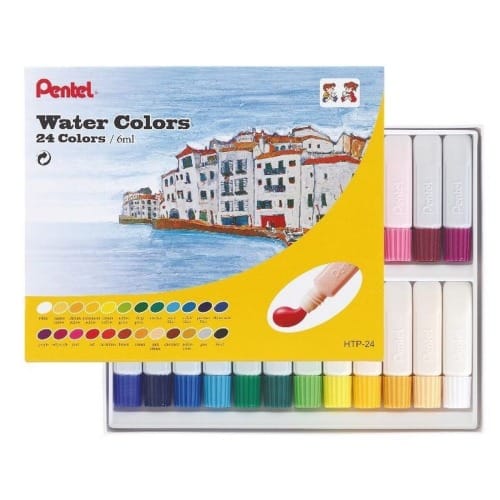
- Pentel Watercolour 24 tubes, 18 tubes and 12 tubes: 5ml tubes from Japanese brand Pentel, easy to blend.
- Camel Artist Watercolour 12 × 5ml: Camlin’s artist-range tubes, with clear, bright colour.
- Art Nation Solid Watercolour 12 and 36 colours: neat solid-pan sets, great for sketching and travel.
- Camel Watercolour Cakes 12 and Camlin Cakes 24: simple, reliable school sets.
Prices change, so see each product page for today’s price. Browse all watercolours, or try watercolour pencils.
What else you need
- Paper: the most important item. See our watercolour paper guide.
- Brushes: a round brush with a good point, such as the DOMS Studio Round, or a Sakura water brush for travel. Our brush guide explains the shapes.
- Palette: a white palette such as the Mont Marte oval palette shows your mixes clearly.
- Extras: two water jars (one for rinsing, one clean), a tissue or sponge, and masking tape.
Basic watercolour techniques
- Wet-on-dry: paint on dry paper for crisp, controlled edges.
- Wet-on-wet: paint onto damp paper for soft, flowing blends, such as skies.
- Graded wash: add more water with each stroke to fade a colour from strong to light.
- Lifting: dab wet paint with a clean, damp brush or tissue to make highlights such as clouds.
Beginner tips
- Work from light to dark. Watercolour is transparent, so you plan your lightest areas first and add darker layers on top.
- Use more water for lighter tones instead of adding white.
- Let layers dry before adding detail, unless you want them to blend.
- Practise mixing with just a few colours: a warm and a cool version of red, yellow and blue will mix most colours.
Frequently asked questions
How many colours do I need?
Twelve is plenty to learn colour mixing. Many artists paint with only six to eight colours.
Are watercolour tubes better than pans?
Neither is better. Tubes are easier for large washes; pans are tidier and better for travel and sketching.
Why do my watercolours look muddy?
Usually from mixing too many colours together, or painting over a layer before it is dry. Keep mixes to two or three colours and keep your rinse water clean.
Do you deliver islandwide?
Yes. We deliver across Sri Lanka in 2–5 working days, with cash on delivery, card or bank transfer. You can also visit our shops in Boralesgamuwa and Horana, open every day from 9 AM to 6 PM.
Not sure what to choose? WhatsApp the Haanz team on 0711 515 515 and we’ll help you choose a watercolour set.
More Haanz Art Guides
 Acrylic Retarder: How to Slow Down Acrylic Paint DryingRead the guide →
 Best Acrylic Paints for Beginners in Sri Lanka (2026 Guide)Read the guide →
 Oil Colours for Beginners: Paints, Mediums and First StepsRead the guide →
 UV Resin for Beginners: How to Use It and What You NeedRead the guide →